
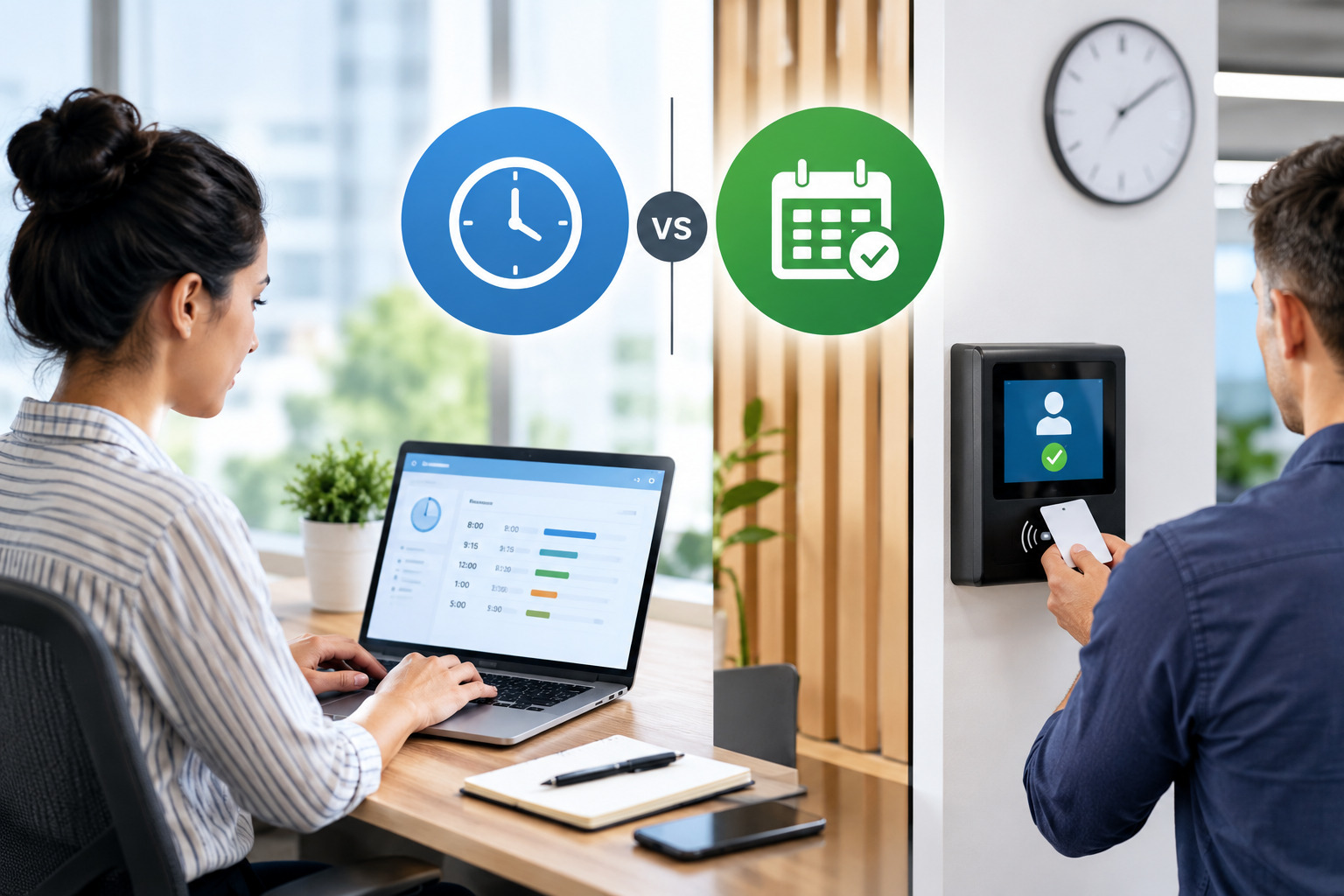
Managing employees effectively requires businesses to understand when employees work, how long they work, and whether they follow their assigned schedules. Two important concepts that support these responsibilities are time tracking and attendance management. Although the terms are often used together, they serve different purposes.
Time tracking focuses on the hours employees work, while attendance management focuses on whether employees are present as expected. Both help businesses maintain accurate records, improve workforce planning, and support reliable payroll processing.
For example, a company may use attendance records to determine whether an employee arrived for a scheduled shift. Its time-tracking system may then record the employee’s clock-in and clock-out times to calculate the hours worked. When these processes work together, managers can better understand attendance patterns, review working hours, and identify discrepancies before payroll is processed.
Understanding the difference between time and attendance is especially important for businesses with hourly employees, rotating shifts, remote teams, multiple locations, or strict attendance policies. Choosing the right processes and software can help reduce administrative work while improving workforce visibility.
In this guide, we will explain what time tracking and attendance management mean, how they differ, their benefits, and how businesses can use both to manage their workforce more effectively.
What Is Time Tracking?
Time tracking is the process of recording how much time an employee spends working during a particular period. Depending on the business, it may include daily working hours, overtime, project hours, task duration, and time allocated to specific clients or departments.
Businesses use time-tracking records to understand labor hours, calculate earnings for hourly employees, monitor workloads, and support payroll preparation. These records can be collected manually through timesheets or digitally through time-tracking software.
For example, an employee may begin work at 9:00 AM, take a recorded break, and finish at 5:30 PM. A time-tracking system records the relevant entries and calculates the working time according to the organization’s configured rules.
Time tracking can also help businesses understand how employees distribute their hours across different activities. A service company might track time spent on customer projects, while a warehouse may focus on shift hours and overtime.
Common Features of Time Tracking
A time-tracking process or software solution may include:
- Clock-in and clock-out records.
- Daily, weekly, or monthly timesheets.
- Calculation of recorded working hours.
- Overtime and break records.
- Project or task-based time allocation.
- Timesheet submission and approval workflows.
- Reports for reviewing employee hours.
The features available depend on the software and the business’s requirements. Accurate results still require employees to record time correctly and managers to review exceptions.
What Is Attendance Management?
Attendance management is the process of monitoring whether employees attend work according to their assigned schedules, shifts, and applicable workplace policies. It helps businesses record attendance status and identify patterns such as lateness, absences, missed shifts, and leave.
Attendance management answers questions such as: Did the employee report for the scheduled shift? Was the employee late? Was an absence approved? Did the employee follow the organization’s attendance procedure?
For example, an employee may be scheduled to begin work at 9:00 AM. Attendance records can show whether the employee arrived on time, arrived late, or did not report for work. Managers can then review the situation according to the company’s policies.
Attendance management is useful for businesses that need reliable staffing, predictable shift coverage, and clear records of employee presence. It is particularly valuable in retail, healthcare, manufacturing, hospitality, customer service, and other environments where employees must be available at specific times.
Common Features of Attendance Management
Attendance systems and processes may include:
- Daily attendance records.
- Late arrivals and early departures.
- Absence and leave records.
- Missed attendance notifications.
- Shift attendance monitoring.
- Attendance summaries and reports.
- Notifications for managers when coverage may be affected.
Some systems also support biometric devices, employee cards, mobile attendance, or location-based clock-ins. Businesses should choose methods appropriate to their workforce and follow applicable privacy, security, and employment requirements.
Time and Attendance: Key Differences
Time tracking and attendance management are closely related, but they serve different purposes. Time tracking records the hours employees work, whereas attendance management monitors whether employees are present as scheduled.
The following table highlights the main differences.
| Comparison factor | Time tracking | Attendance management |
|---|---|---|
| Main purpose | Records working hours | Monitors employee presence and attendance |
| Primary question | How much time did the employee work? | Did the employee attend as scheduled? |
| Main records | Clock-in/out times, timesheets, hours worked | Presence, absences, lateness, leave |
| Focus | Working time and labor hours | Attendance patterns and schedule compliance |
| Payroll role | Helps calculate payable hours and overtime | Helps identify absences and attendance-related adjustments |
| Management use | Work-hour analysis and labor-cost planning | Shift coverage and attendance monitoring |
| Common reports | Hours worked, overtime, project hours | Absence rates, lateness, attendance summaries |
| Typical users | Payroll teams, project managers, supervisors | HR teams, workforce managers, supervisors |
Although the two processes are different, they often use some of the same data. For example, a clock-in record may help establish that an employee arrived at work and provide the starting point for calculating recorded working hours.
However, attendance alone does not always establish how many hours were worked, and time records alone may not explain why an employee missed a shift. Businesses often benefit from managing both together.
Time Tracking vs. Attendance Management: A Practical Example
Consider a retail business that schedules an employee to work from 9:00 AM to 5:00 PM.
The employee arrives at 9:15 AM and clocks in. Later, the employee takes a break and finishes work at 5:00 PM.
The attendance process records that the employee arrived 15 minutes after the scheduled start time. The time-tracking process records the actual clock-in and clock-out entries and calculates the recorded hours according to the business’s rules.
The manager may need to investigate the late arrival, while the payroll team uses verified working-hour records to prepare the employee’s pay.
This example shows why the two processes should not be treated as interchangeable. Attendance records help explain whether an employee followed the schedule, while time records help establish the hours recorded for work.
There are also situations in which the records may differ for legitimate reasons. An employee might attend a training session outside their usual shift, work approved overtime, or be assigned to another location. Businesses should review these cases rather than automatically treating every difference as an error.
Why Are Time Tracking and Attendance Both Important?
Managing time and attendance together helps businesses maintain reliable employee records and make better workforce decisions.
1. More Accurate Payroll Processing
Payroll teams need reliable information about working hours, approved overtime, leave, and other pay-related adjustments. Time tracking provides working-hour records, while attendance information can help identify absences and discrepancies that require review.
When both processes are managed consistently, businesses can reduce manual corrections and prepare payroll with greater confidence. Employers should still verify the records and apply the wage, overtime, and leave rules relevant to their workforce.
2. Better Workforce Planning
Attendance information helps managers understand whether employees are available for their assigned shifts. Time-tracking data helps them understand how working hours are distributed.
Together, these records can reveal staffing challenges, recurring overtime, and periods when additional coverage may be needed.
For example, a restaurant that frequently experiences last-minute absences may use attendance reports to improve backup staffing, while time records can help managers evaluate how overtime affects labor costs.
3. Improved Employee Accountability
Clear procedures help employees understand when they are expected to work and how their hours should be recorded. Consistent records also make it easier to investigate discrepancies fairly.
Businesses should explain their policies, provide a straightforward way to report errors, and ensure that employees can request corrections when records are inaccurate.
4. Reduced Administrative Work
When attendance records, timesheets, and approvals are managed separately, HR teams may spend considerable time comparing files and following up on missing information.
A centralized process can reduce duplicate data entry, make outstanding approvals easier to identify, and help managers investigate discrepancies before they affect payroll.
5. Better Compliance and Recordkeeping
Businesses may need to maintain records relating to working hours, overtime, breaks, attendance, or leave, depending on applicable laws and employment arrangements.
Organized time and attendance records make it easier to review historical information and respond to questions about hours worked or absences. The specific records that must be maintained depend on the jurisdiction and type of employment.
Businesses can also reduce timesheet errors and improve payroll accuracy by reviewing working hours, checking unusual entries, and establishing consistent approval procedures.
Common Time and Attendance Problems Businesses Face
Even when businesses understand the difference between time tracking and attendance management, maintaining accurate records can be challenging.
Missed Clock-Ins and Clock-Outs
Employees may forget to record the start or end of a shift. This creates incomplete time records and may require managers to verify the actual hours worked.
Businesses can reduce these incidents through simple clock-in procedures, timely reminders, and a documented process for correcting missing entries.
Late Arrivals and Unplanned Absences
Unexpected absences and late arrivals can leave shifts understaffed, especially when employees work in customer-facing or operational roles.
Clear notification procedures, reliable attendance records, and effective scheduling help managers respond more quickly when coverage changes.
Incorrect Timesheet Entries
Manual data entry can introduce errors in dates, start times, end times, and break durations. These mistakes can affect the recorded hours used during payroll preparation.
Encouraging employees to review their entries daily and asking managers to investigate unusual records can reduce the likelihood of errors.
Confusion About Overtime
Attendance records may show when an employee was present, but managers also need reliable information about actual working time and applicable overtime rules.
Businesses should explain how overtime is recorded, how approvals work, and how payroll determines payable hours. Hours worked should be recorded accurately and handled according to applicable employment requirements, even when they differ from a planned shift.
Disconnected Scheduling and Timekeeping Systems
When scheduling, attendance, and time tracking are managed through separate tools, managers may struggle to identify discrepancies. A shift change may not be reflected in every record, or approved overtime may require manual updates.
Connecting these processes where practical can improve visibility, provided the systems are configured correctly and the resulting records are reviewed.
How to Manage Time and Attendance More Effectively
Businesses can improve their processes by establishing clear policies and choosing tools that fit their staffing requirements.
1. Establish Clear Workplace Policies
Define when employees should start and finish work, how attendance is recorded, how breaks are documented, and how absences or late arrivals should be reported.
The policy should also explain timesheet deadlines, overtime procedures, correction requests, and the responsibilities of employees and managers. Consistent rules make it easier for everyone to follow the same process.
2. Use Digital Time and Attendance Software
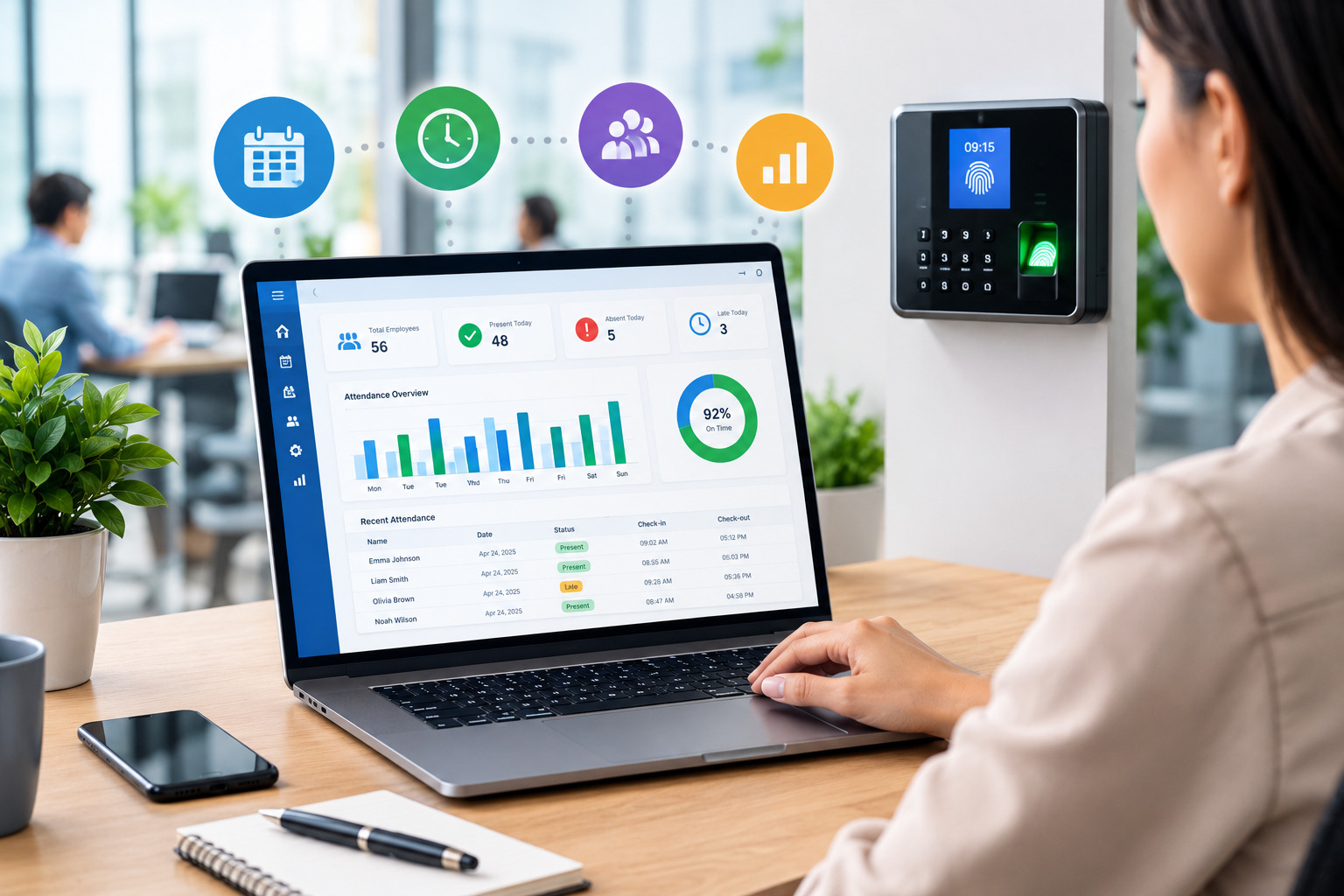
Digital systems can centralize attendance records and working-hour data. Depending on the product, they may provide clock-in/out functions, timesheet calculations, absence alerts, approval workflows, and reporting.
Automation can reduce repetitive administrative tasks, but the system must be configured correctly. Businesses should also train employees and regularly review exceptions.
3. Connect Employee Scheduling With Time Records
Scheduling establishes when employees are expected to work, while attendance and time records show what actually happened.
Comparing these records helps managers investigate late arrivals, missed shifts, unexpected overtime, and changes in shift coverage. Legitimate differences should be verified rather than automatically treated as errors.
For businesses with complex shift patterns, centralized scheduling can make it easier to coordinate employees across departments or locations.
4. Review Records Regularly
Do not wait until payday to investigate missing or unusual records. Daily or weekly reviews can help identify errors while employees and managers still remember the relevant details.
Managers should check incomplete entries, unusually long shifts, duplicate records, and unresolved approval requests. Corrections should be documented so that the final records remain understandable and traceable.
5. Train Employees and Managers
Employees need to know how to record time and attendance, while managers need to understand how to approve entries and investigate discrepancies.
Provide clear instructions when introducing new software or changing workplace policies. Short refresher sessions can also help reduce recurring mistakes.
6. Protect Employee Information
Time and attendance systems may contain sensitive employment information. Restrict access to authorized personnel, establish appropriate retention policies, and use suitable security controls.
If a business uses biometric, mobile-location, or other monitoring features, it should assess privacy implications and follow applicable legal requirements.
What Is Time and Attendance Software?
Time and attendance software is a digital solution that helps businesses record employee working hours and monitor attendance through a centralized system. Some products focus primarily on clock-ins, absences, and attendance reports, while others combine these features with scheduling, timesheets, overtime management, and payroll integrations.
The right solution depends on how the business operates. A small office with fixed working hours may need only basic attendance and timesheet features. A business with multiple locations, rotating shifts, or hourly employees may require more advanced scheduling, approval, and reporting capabilities.
Before selecting a system, businesses should evaluate:
- Time recording: Can employees record their hours easily and accurately?
- Attendance monitoring: Can managers identify absences and late arrivals?
- Scheduling support: Can planned shifts be compared with actual attendance?
- Timesheet approvals: Can employees and managers review and correct entries?
- Payroll integration: Can approved data transfer reliably into the payroll process?
- Reporting: Can the system produce useful summaries of hours and attendance?
- Security and access: Can employee information be protected appropriately?
- Ease of use: Can employees across different roles and locations use the system consistently?
A useful system should simplify everyday work rather than create additional administrative complexity. Businesses should assess the available features against their actual needs instead of assuming that every product offers the same capabilities.
Benefits of Integrating Time Tracking and Attendance Management
When time tracking and attendance management work together, businesses can gain a more complete view of their workforce.
More reliable records: Managers can compare scheduled shifts, attendance information, and recorded working hours to identify discrepancies that need investigation.
Simplified payroll preparation: Verified working hours and relevant attendance information can help payroll teams review records before calculating payments.
Improved scheduling decisions: Attendance patterns and actual working hours can help managers identify recurring staffing gaps and adjust future schedules.
Faster reporting: Centralized information can reduce the time spent collecting data from different spreadsheets, forms, or systems.
Better employee experience: Clear policies and consistent records make it easier for employees to understand their schedules, check their hours, and raise questions about discrepancies.
Integration is most effective when businesses define clear responsibilities and review the information generated by their systems. Technology can support accurate records, but it cannot replace sound policies and proper oversight.
Which Is Better for Your Business: Time Tracking or Attendance Management?
Neither approach is a complete replacement for the other. The right choice depends on the problems a business needs to solve.
| Business requirement | Primary focus |
|---|---|
| Calculating hours worked | Time tracking |
| Monitoring late arrivals and absences | Attendance management |
| Reviewing overtime and timesheets | Time tracking, supported by attendance records |
| Ensuring scheduled shifts are covered | Attendance management and employee scheduling |
| Preparing reliable payroll records | Both |
| Managing rotating shifts across locations | Integrated scheduling, time, and attendance processes |
Businesses with simple fixed schedules may be able to manage these processes using separate tools. Organizations with hourly workers, changing shifts, or multiple locations may benefit more from a solution that brings scheduling, time tracking, and attendance together.
The most important consideration is whether the chosen process provides accurate information, supports the business’s policies, and makes it easy to identify and resolve discrepancies.
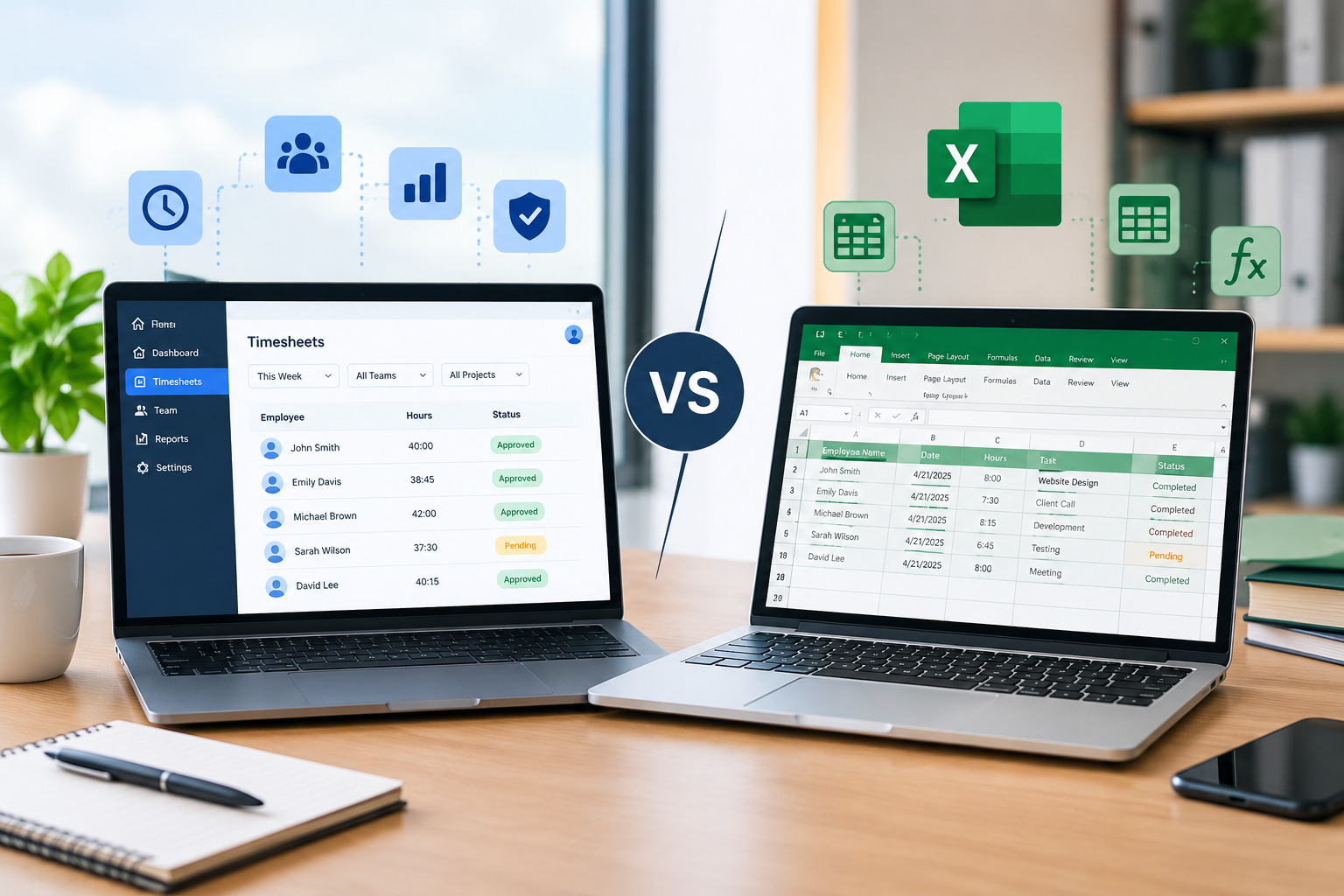
Businesses comparing manual spreadsheets with digital tools can read our guide to timesheet software vs. Excel to evaluate the differences in recordkeeping and workflow management.
Conclusion
Time tracking and attendance management are related but serve different purposes. Time tracking records how much time employees work, while attendance management monitors whether they are present according to their assigned schedules and workplace policies.
Both processes are important for reliable payroll preparation, effective workforce planning, and organized employee records. When businesses manage them together, they can identify discrepancies more easily, reduce repetitive administrative work, and make better-informed staffing decisions.
By establishing clear policies, using appropriate software, reviewing records regularly, and training employees, businesses can build a more consistent time and attendance process.
Recent Posts
- Time and Attendance Software: Complete Guide for Employers
- Time and Attendance: What’s the Difference Between the Two?
- How to Reduce Timesheet Errors and Improve Payroll Accuracy

- Timesheet App for Employees: Features, Benefits & Best Practices

- Timesheet Software vs. Excel: Which Is Better for Businesses?
Stay Ahead. Simplify Workforce Management.
Empower your teams to work efficiently with a unified workforce platform built for clarity, control, and actionable insights across your organization.